




Outfitting a middle school cheer squad involves challenges that most other team sports do not face. The athletes are still growing, coverage expectations from schools and parents tend to be strict, and program budgets often answer to a booster committee rather than a single purchasing department. Choosing cheer uniforms for middle school means balancing all three factors at once.
This guide walks through the decisions that determine whether a middle school cheerleading uniform program works in practice: what to confirm before ordering, coverage details appropriate for this age group, how to size athletes who may not be done growing, which uniform styles serve middle school teams, and how to build a complete budget that accounts for every component — not just the shell top and skirt.
Middle School Cheer Uniform Requirements
Before requesting a quote, gather the information listed below. Each item affects the uniform specification, and missing one at the start typically leads to a costly adjustment after samples arrive.
School dress code. Many middle schools publish athletic uniform guidelines that specify minimum skirt length, neckline type, sleeve requirements, or midriff coverage. Some districts follow NFHS spirit rules that set additional standards for school-sponsored competitions. Obtain the written policy, not a verbal summary from memory.
Athlete age range. Middle school typically covers ages 11 a 14. Athletes in this range can differ significantly in physical development, which affects both sizing and coverage needs. Programs with sixth-graders on the roster often require more conservative cuts than squads limited to eighth-graders.
Sideline or competition use. Sideline uniforms for football or basketball games face different demands than competition uniforms. Sideline sets may need to accommodate cooler weather and layering, while competition uniforms prioritize visual impact under arena lighting.
Season of use. Fall, winter, and spring each present different temperature and weather conditions. A uniform designed for a single season can be built differently from one that must work across multiple seasons with layering.
Proportion of outdoor games. If the team spends significant time outdoors, peso de la tela, wind resistance, and layering options become more important. Outdoor use also affects how quickly the uniform shows wear.
Expected uniform lifespan. Will the uniforms last one season or two to three? The answer affects sizing decisions, fabric durability requirements, and overall budget allocation.
Documenting these points before contacting a supplier prevents the most common ordering problem: a uniform that meets one requirement but fails another nobody stated upfront.
Age-Appropriate Design and Coverage
Coverage for middle school cheerleaders tends to be more conservative than high school or college programs. The design elements that determine coverage levels:
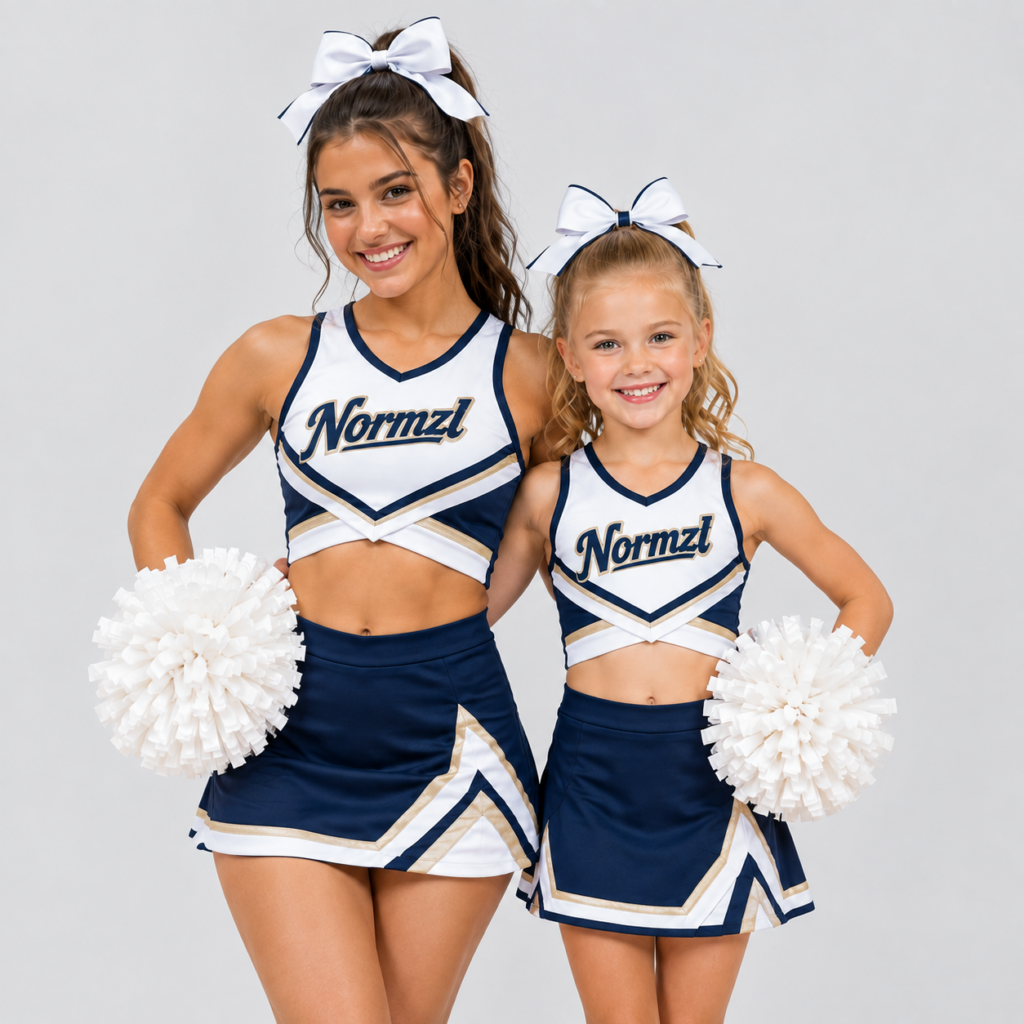
Full-length tops. A top extending to the hip or below covers the midriff completely through arm raises, salta, y cayendo. Cropped tops common on older squads leave the midsection exposed during overhead motion and are unsuitable for most middle school dress codes. The extra length must be patterned so the top does not bunch during movement.
Appropriate neckline. A crew neck or raised V-neckline provides more chest coverage than a deep V. The neckline should stay in place during forward bends and jumps without the athlete needing to adjust it between motions.
Built-in safety shorts. Compression-style shorts worn under the skirt provide security during high kicks, lanzamientos de canasta, and inversions. When integrated at the pattern stage, they stay in place without shifting. Athletes who feel secure in their uniforms perform with more confidence.
Body liner. A fitted layer worn under the top fills gaps at the neckline, armholes, and midriff. Liners designed for cheer (Bodies & Revestimientos) stay positioned during dynamic movement better than a separate undershirt, which tends to ride up.
Skirt length. A skirt reaching mid-thigh to just above the knee when standing provides adequate coverage during jumps and kicks. The exact length should be confirmed on a moving athlete, not measured flat on a table.
Sheer fabric limitations. Mesh or sheer panels can create coverage problems when stretched or wet. For middle school uniforms, any sheer fabric should be placed over an opaque underlayer in visibility-sensitive areas. Solid fabrics are the safer default for this age group.
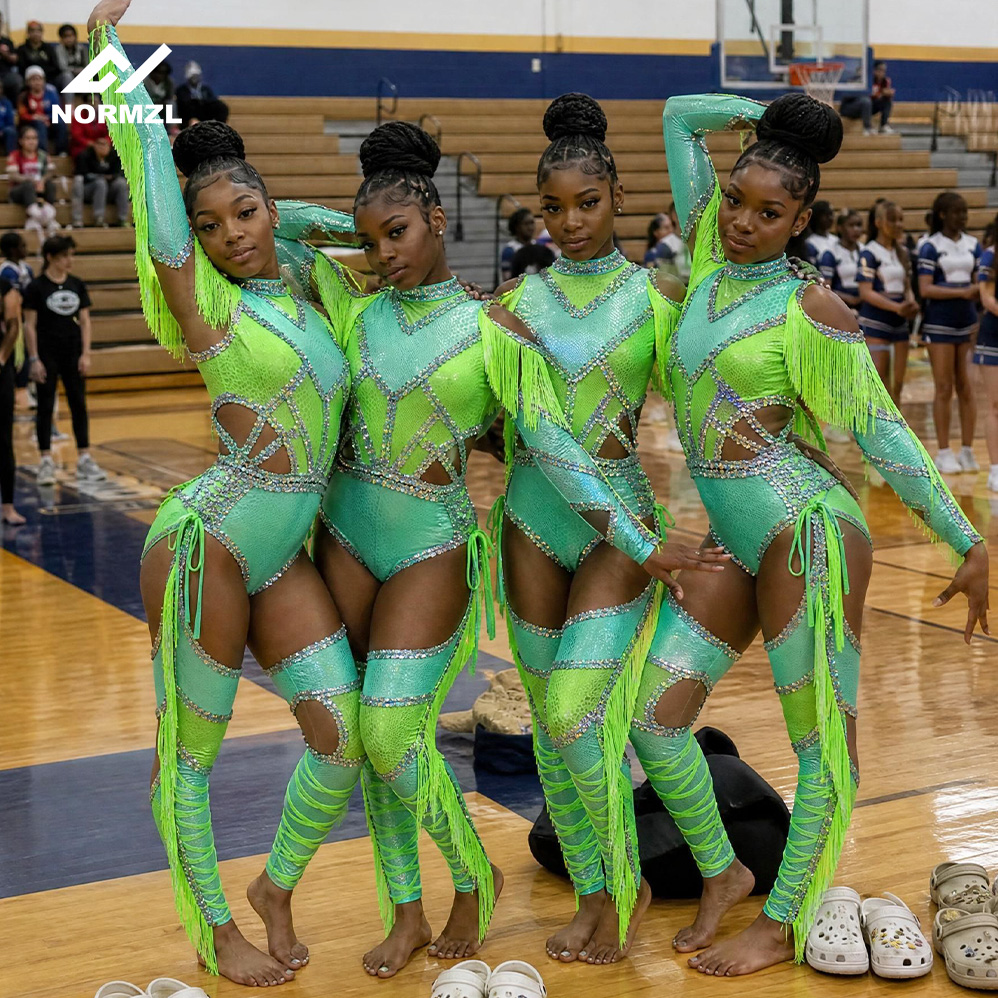
Avoid unnecessary cutouts. Keyhole backs, side cutouts, and open-back designs reduce coverage. For middle school programs, minimizing these in favor of continuous fabric reduces exposure concerns. Limpio, simple designs tend to look more polished on younger squads.
Sizing Athletes Who Are Still Growing
Sizing is one of the most difficult aspects of outfitting a middle school team. Athletes in the same grade can span several sizes, and they will continue growing throughout the season and beyond.
Cannot choose size by age or grade alone. A 12-year-old may fit a youth small while another 12-year-old in the same grade requires an adult medium. Size must be determined by actual body measurements, not by the grade the athlete is in. Using the manufacturer’s Tabla de tallas del uniforme Cheer for each athlete avoids the assumptions that lead to the most exchanges and alterations.
Reasonable growth allowance. Ordering each uniform slightly roomy — enough for the athlete to grow into over the course of a season — is standard practice. A small amount of extra room in the torso (roughly one inch) or waist (half an inch to an inch) can extend usable life without compromising fit at the start of the season.
Why buying much larger does not actually extend usable life. A uniform two sizes too large looks oversized in photos, bunches during stunts, and has a skirt length inconsistent with the rest of the team. The athlete grows into the width before growing into the length, meaning the uniform looks wrong for months before it briefly fits — and then may be too short before the next season. The net lifespan gain is minimal while the fit penalty is immediate.
How to handle height-vs-girth mismatch. A tall, thin athlete and a shorter, stockier athlete may both nominally fit the same size, but the uniform hangs differently on each body. When measurements span two sizes, fit to the larger measurement and tailor the other dimensions. Some manufacturers offer mixed sizing — pairing different top and bottom sizes for one athlete — which handles this mismatch without requiring a fully custom pattern.
Measuring each athlete against the manufacturer’s size chart at the time of order, rather than relying on what the athlete wore previously, remains the most reliable method.
Best Uniform Styles for Middle School Teams
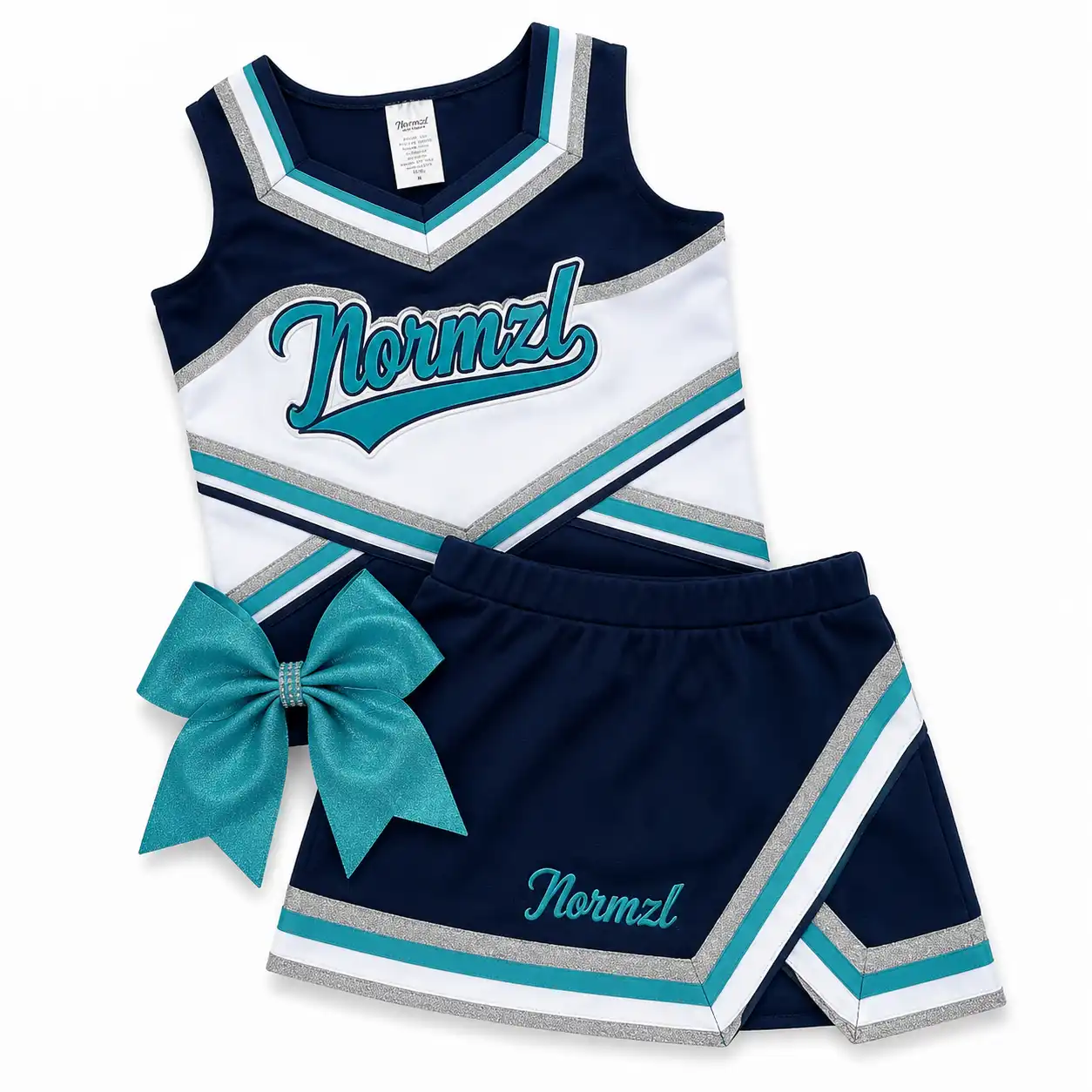
Several uniform configurations work for middle school cheerleading uniforms. The right choice depends on the team’s primary use, coverage requirements, and climate.
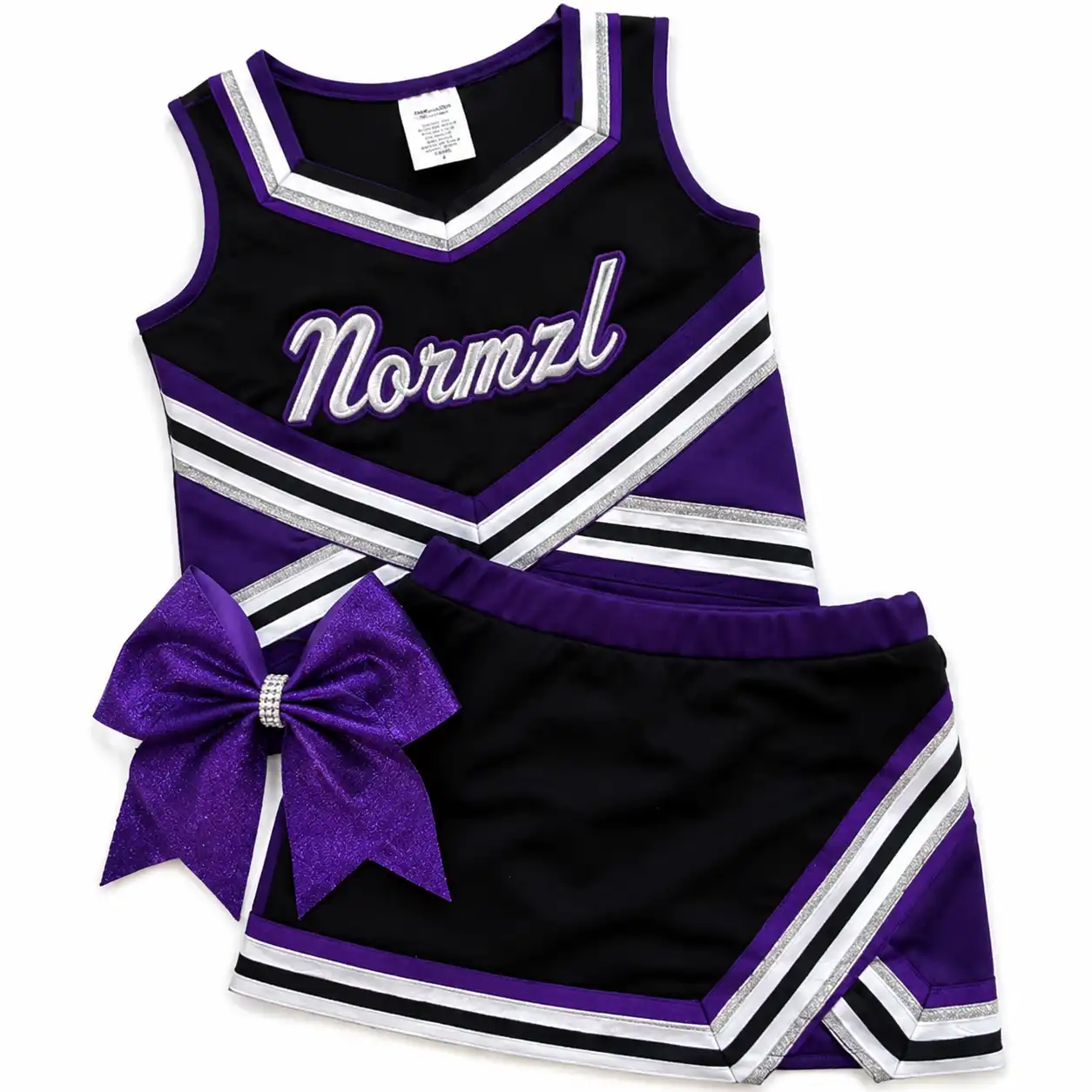
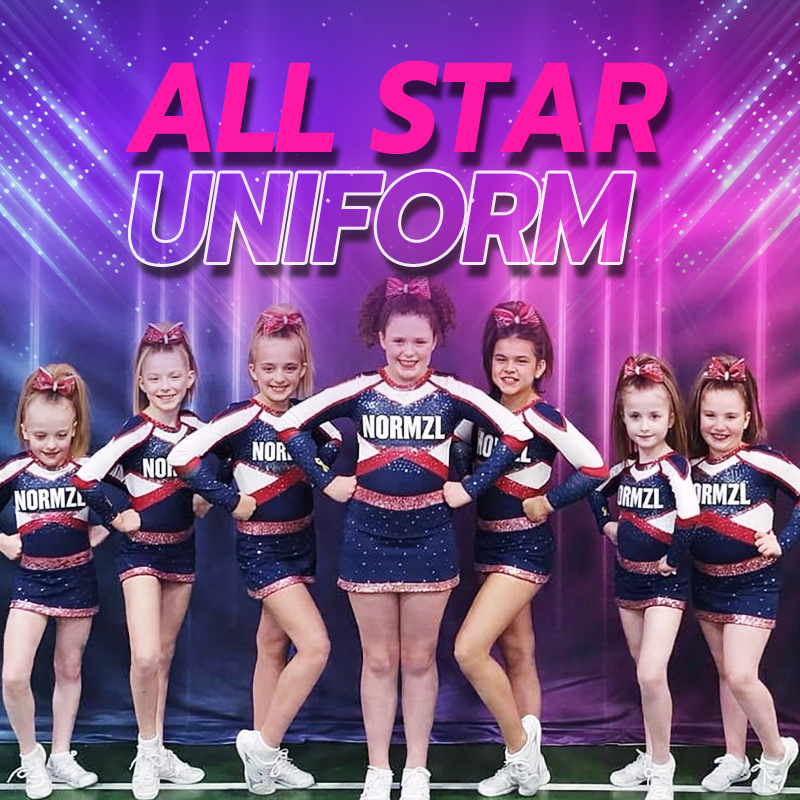
Shell top and skirt. The traditional two-piece competition uniform. A fitted shell top with a pleated skirt offers good range of motion and a clean competition look. Coverage at the midriff depends on the top’s cut — a longer shell or one with an integrated liner addresses midriff exposure. This style works well for indoor competition and warm-weather sideline use.
Long-sleeve uniform. A top with sleeves running to the wrist, suitable for cooler weather and outdoor events. The key construction point is the underarm: a long sleeve not cut with adequate range of motion will restrict overhead movement, which is a constant requirement in cheer. A well-patterned long-sleeve top allows full arm reach without binding.
Full-length top and shorts. A more coverage-oriented option, pairing a full-length top with athletic shorts instead of a skirt. This style suits schools with strict dress codes or teams that spend significant time outdoors. The shorts are typically compression-style, providing security during stunts. The top-and-short combination can use the same stretch fabrics as a traditional uniform, maintaining mobility despite the additional coverage.
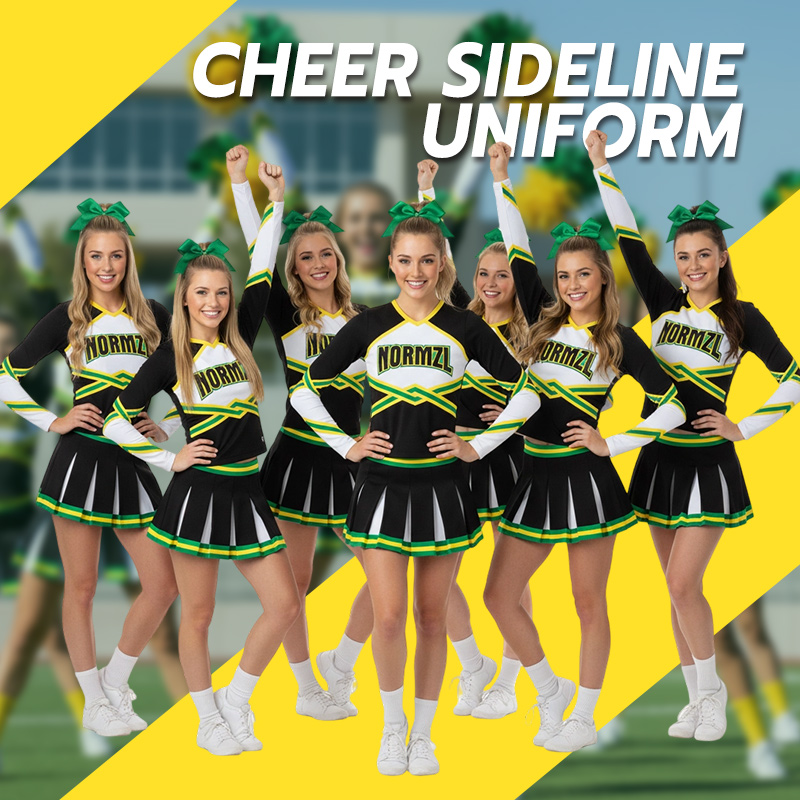
Sideline uniform. Designed specifically for game-day sideline use rather than competition. Sideline sets often include a shell or long-sleeve top with school colors and numbers, paired with shorts or a skirt, and may incorporate a warmup layer for cold-weather games. Explore Línea de banda & alegría escolar options for styles built for regular game-day use. These uniforms see more outdoor wear and typically prioritize durability and layering over competition-level visual detail.
Convertible uniform with liners or warmups. A base uniform designed to work with add-on layers — removable sleeves, warmup jackets, or interchangeable liners — allowing the same uniform to serve multiple conditions. This approach can reduce the total number of garments a program needs to purchase, which matters when budget is constrained.
Build a Complete Budget
A middle school cheer uniform budget needs to account for every component, not just the shell. The table below lists the typical items in a complete uniform package. Unit costs depend on fabric, decoration complexity, and order quantity — confirmed at quote.
| Componente | Description | Typical Priority |
|---|---|---|
| Main uniform (arriba + skirt/shorts) | Shell or long-sleeve competition or sideline set | Required |
| Body liner | Fitted coverage layer under the top | Recommended for middle school |
| Safety shorts / bloomers | Compression shorts under the skirt | Required for middle school |
| Bow | Hair bow matching team colors | Standard accessory |
| Pom-poms | For competition and sideline use | Standard accessory |
| Warmup jacket or vest | Pre-game and sideline warmth | Season-dependent |
| Shoes and socks | Cheer-specific shoes with team socks | Required |
| Backup and reorder allowance | Spare uniforms for new or replacement athletes | Recommended |
The main uniform represents the largest single cost per athlete. Sin embargo, body liners, safety shorts, zapatos, and accessories add up quickly across a full roster. Programs that omit these from the initial budget often find themselves returning for smaller, more expensive reorder runs later.
Warmup jackets are a seasonal decision. For teams in colder climates or those with significant outdoor sideline time, the warmup is a functional necessity rather than an optional extra. For indoor-only competition teams, the budget priority may shift toward additional backup uniforms instead.
Backup uniforms deserve specific attention. Middle school rosters change — athletes transfer, grow unexpectedly, or join mid-season. Keeping two to three complete uniforms in a range of sizes as reserve stock avoids the rush of a single-unit reorder, which typically costs more per piece than a bulk order.
How to Control Cost Without Sacrificing Quality
Several design and ordering decisions directly affect uniform cost. The options that tend to deliver the most savings for middle school programs:
Reduce complex decoration. Patrones de diamantes de imitación, embroidered logos, and multi-color sublimation each add cost. A simpler decoration scheme — fewer stone placements, a single embroidered logo, or a two-color sublimation — reduces the per-unit price without making the uniform look plain. For middle school programs, clean school colors with minimal decoration often read well from the stands.
Prioritize wash-durable fabrics. A uniform that survives repeated machine washing without fading, pilling, or losing shape lasts longer between replacements. The fabric cost may be slightly higher initially, but the replacement cycle extends — a net savings for programs on annual budgets. Polyester-spandex blends are commonly used for their durability and color retention.
Use 2–3 core colors. Each additional color in a uniform design adds setup cost for sublimation, serigrafía, or color-block fabric sourcing. Sticking to the school’s two or three primary colors keeps decoration costs contained and makes the uniform easier to match with accessories.
Limit individual athlete customization. Adding individual names or numbers to the uniform shell increases per-unit decoration cost and limits the uniform’s usable life to that specific athlete. Keeping personalization off the outer shell — or limiting it to removable tags — extends the uniform’s usable life if the roster changes.
Keep designs usable across seasons. A uniform design that works for both fall and spring competition, or for both sideline and competition use, reduces the need for separate seasonal sets. Classic styling rather than trend-driven details helps the uniform remain presentable across multiple years, extending the return on each set purchased.
Sample Approval With Students and Parents
Before committing to bulk production, conduct a sample fitting with actual middle school athletes. The approval process:
Select athletes of different body types for fitting. Do not fit on only one athlete. Choose representatives covering the size range of the roster — petite, average, and larger builds — to confirm the uniform works across body types.
Check movement and coverage. Have the fitting athletes perform the movements they will actually do: arm raises, salta, a tumbling pass if applicable, and a stunting simulation. Check that coverage holds through each movement and that no garment component shifts out of position.
Record school and parent feedback. Share the sample with the athletic director and a small group of parents. Collect specific feedback on neckline height, longitud de la falda, sleeve coverage, y apariencia general. Document concerns in writing.
Do NOT start bulk production before approval. A sample signed off by the coach, athletic director, and parent representative is the production trigger. Starting production before formal approval risks a full reorder if the sample does not meet expectations after broader review.
Preguntas frecuentes
How much do middle school cheer uniforms cost?
The cost depends on the uniform style, tela, decoration complexity, y cantidad del pedido. A basic shell top and skirt set costs less per unit than a fully decorated competition uniform with integrated liners. The total program cost includes body liners, safety shorts, zapatos, arcos, pompones, and potentially warmups — components that can equal or exceed the shell cost across a full roster. Contact a supplier with your specific requirements for a detailed quote.
What should middle school cheerleaders wear under uniforms?
A fitted body liner under the top and compression shorts under the skirt are standard. The body liner fills gaps at the neckline and armholes and stays in place during motion. For teams concerned about midriff coverage, a bodysuit-style liner provides full torso coverage without shifting. Separate undershirts tend to ride up and require adjustment between movements.
How should a middle school cheer uniform fit?
The uniform should be fitted but not tight, with enough room for full range of motion. The top should not ride up during arm raises. The skirt should provide coverage during jumps and kicks. The shoulder seam should sit at the shoulder point, not hanging below it. Actual measurements against the manufacturer’s size chart are the most reliable sizing method.
Should schools buy uniforms with room to grow?
A small amount of growth room is reasonable — roughly one inch in the torso or half an inch to an inch in the waist. Buying significantly larger than the athlete’s current measurements does not meaningfully extend the uniform’s usable life and creates fit problems during the months before the growth spurt arrives. Measuring each athlete at the time of order and allowing modest room is the practical approach.
Pensamientos finales
Outfitting a middle school cheer team involves decisions that go well beyond picking a style and a color. Fit for athletes still growing, coverage appropriate for the age group, and a budget that accounts for every component — these are the factors that determine whether the uniform program works through the season or creates problems at the first game.
Create Your Team’s Championship Look