




Male cheerleaders need uniforms built on a male pattern block, not a scaled-up women’s cut or a generic unisex athletic shirt. Shoulder width, chest-to-waist ratio, rise, inseam, and the range of motion required for stunting and tumbling all call for separate pattern and sizing decisions. When a coach or purchaser treats male cheer uniforms as an afterthought of the women’s order, the result is tops that ride up during arm movements, pants that bind at the thigh during jumps, and a team that looks uneven on the competition floor.
This guide walks through the measurements, fit checkpoints, and combination decisions that go into ordering male cheerleader uniforms for a competitive roster. It covers how the top and bottom should sit on a male body, what to measure and how each number affects the pattern, how stunting changes the fit conversation, and how to keep the male pieces visually aligned with the female uniforms on the same team.
Male cheer uniforms should be built on a male pattern block, not a scaled-up women’s cut. Confirm the eight measurements, the top-and-bottom combination, and a controlled try-on before ordering for a coed roster.
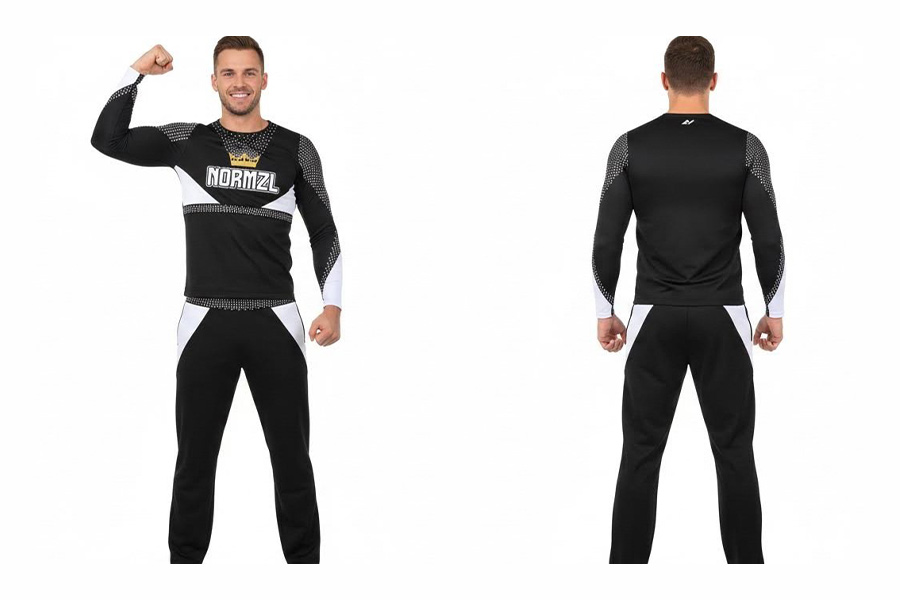
How Should a Male Cheer Uniform Fit?
A properly fitted male cheer top should follow the body’s lines without compressing it. The shoulder seam sits at the edge of the shoulder, not sliding down the arm or pulling toward the neck. When the arms are raised overhead, the hem should stay near the waistline. For competitive routines that include stunting, the shoulder area must allow full rotation without the garment shifting.
The pants or shorts need to support deep squats, broad jumps, and stunting positions without binding at the thigh or knee. The waistband should remain at the natural waist through tumbling passes and inversions. If the waistband slips during a back handspring, the athlete is adjusting his uniform instead of focusing on the routine.
Fit preference depends on the scenario. A fitted cut is typical for competition, where clean lines read well from the stands and under arena lighting. A slightly relaxed cut may be preferred for sideline cheering, where the uniform is worn for longer periods and layered over practice clothing. Teams ordering All-Star Cheer uniforms for competition typically lean toward the fitted end; school programs buying for Sideline School Cheer may prefer a bit more room.
Male Cheer Uniform Measurements
Accurate measurements are the foundation of a correct order. The following eight measurements form the standard data set for a male cheer uniform pattern. Your factory contact can confirm which additional points may be needed for specific styles.
| 測定 | 測定方法 | Effect on Pattern |
|---|---|---|
| 身長 | Stand straight against a wall, no shoes | Determines overall proportion and grade of the pattern |
| Chest | Wrap tape around the fullest part of the chest, arms at sides | Controls the width of the top through the torso and armhole depth |
| ウエスト | Measure at the natural waist, typically near the navel | Determines where the waistband sits and how the top tapers |
| ヒップ | Measure around the fullest part of the seat | Affects the fit of pants through the hip and seat area |
| Shoulder width | From the acromion bone on one shoulder to the other | Controls shoulder seam placement and upper-body proportion |
| 袖丈 | From the shoulder seam to the wrist or desired cuff point | Determines sleeve length and how the armhole is shaped |
| 股下 | From the crotch seam to the ankle bone or desired hem | Controls pant length and how the leg is proportioned |
| Thigh circumference | Around the fullest part of the upper leg | Determines room in the pant leg for squats, lunges, and jumps |
Each measurement connects to the next. Shoulder width influences how the chest measurement is distributed across the upper body; inseam and height together determine whether the pant proportion looks balanced. A complete set of all eight measurements reduces the need for post-delivery alterations and helps the factory produce a consistent fit across the roster. の チアユニフォームのサイズ表 on our site provides the reference framework these measurements feed into.
トップス, Pants or Shorts: Which Combination Works Best?
The combination a team selects depends on the routine, the venue, and the climate. Here are the four most common pairings for male cheerleaders and where each tends to work.
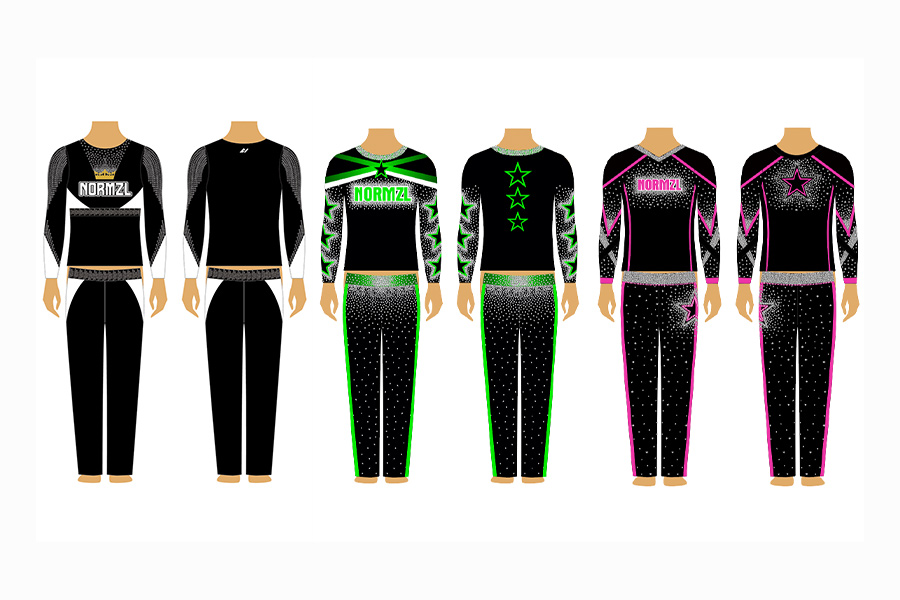
Fitted top with full-length pants. This combination offers the most coverage and the cleanest visual line. It works well for competition routines where the team wants a uniform, streamlined appearance. Full-length pants also provide some warmth for indoor arenas and evening events. The fitted top keeps the silhouette sharp, and the pant length avoids any inconsistency in hem line across the roster.
Fitted top with shorts. Shorts provide more airflow and freedom at the knee, which some athletes prefer for high-energy sideline routines and summer clinics. The trade-off is that shorts expose the leg, which can look inconsistent across team members with different builds. Teams that choose shorts typically select a uniform inseam length and stick with it across the roster.
Sleeveless top with athletic pants. This is a popular competition combination. A sleeveless top maximizes shoulder range of motion and gives a clean, アスレチックな外観. Paired with full-length pants, it balances coverage and mobility. Many カスタムチアアパレル orders for coed teams use this pairing for male members.
Sleeveless top with shorts. The most open combination, typically reserved for warm-weather competition or high-intensity routines where maximum ventilation is a priority.
The context matters. Competition routines call for uniform, fitted combinations that read as one unit from a distance. Sideline cheering allows more flexibility depending on weather. The design language — colors, パターン, decoration — should remain consistent across all combinations so the team reads as one group. Browse the メンズチアアパレル category for examples of how these combinations look in current styles.
Fit Requirements for Stunting and Tumbling
Stunting and tumbling place demands on a uniform that sideline cheering does not. Competitive cheerleading — a sport built around partner stunts, ピラミッド, and tumbling passes, as documented in the Wikipedia entry on cheerleading — requires the uniform to move with the body through lifts, throws, and floor passes. The fit requirements shift significantly when the athlete is lifting a partner overhead, being thrown into the air, or performing handsprings across a mat.
For stunting, the shoulder range of motion is the governing constraint. Bases need to press their arms overhead and hold positions while supporting a flyer’s weight. If the top’s shoulder construction is too tight or the armhole is cut too high, the garment rides up and the seam pulls inward during the hold. A male cheer top typically needs a slightly deeper arm scye and enough body length to stay in place through overhead presses. The torso also twists and bends during stunting transitions, so the top must move with the body rather than against it.
During tumbling, the uniform faces multi-directional forces. A top not anchored at the waist can shift upward during a back handspring. This is why fitted tops are standard for tumbling — the garment stays where it is placed. Pants need to move through a full split without the inseam binding, and the rise should prevent the waistband from dropping during deep squats.
The thigh area needs room for full-range movement without excess fabric. Too tight, and the pant restricts a split jump; 緩すぎる, and the extra material can catch on a partner’s foot during a stunt transition. Finding the right thigh circumference depends on the individual athlete’s build and is one of the measurements most often overlooked in standard sizing charts.
Loose-fitting garments present safety concerns during stunting and tumbling. Excess fabric at the hem, 袖, or pant leg can be grabbed inadvertently by a partner during a stunt. This is a practical reason why competitive male cheerleader uniforms tend toward fitted rather than relaxed cuts. For more on how male cuts compare to unisex options in these movement contexts, our post on 男子vs. ユニセックスチアユニフォーム covers that comparison in detail.
How to Match Male and Female Team Uniforms
A coed cheer team should read as one unit when the squad performs together. Matching the male and female uniforms is a design and proportion task, not simply ordering the same style in different sizes.
The most effective approach is to keep the design vocabulary constant: same colors, same logo placement, same pattern direction. The cut changes between male and female blocks, but the visual language should not. A chevron stripe that lands at the hip on a female top may sit at the waist on a male top — the element is repositioned to account for the different torso proportions, but the color, angle, and width remain consistent so the team photographs as one group.
Coordinating pants with skirts means carrying the same color and trim language across both bottom types. If the female skirt has a specific stripe or binding detail, the male pant can carry the same detail at a position that reads similarly in motion. The goal is continuous visual lines across the squad, not two separate uniform groups.
Decoration density also needs balancing. Male tops have a broader, flatter chest, so the same rhinestone count or twill letter that fills a female top may look sparse on a male top. The decoration layout should be adjusted per block while keeping the design concept intact. Your factory contact can provide layout proofs before bulk production.
Sample Fitting Test
Before finalizing a size list, fit-test a sample set in the key sizes your supplier provides. Have athletes of typical build for each size run through these seven movements:
- Full arm raise. Raise both arms straight overhead. The top hem should not rise significantly above the waistline, and the shoulder seam should stay at the shoulder edge.
- Deep squat. Lower into a full squat. The pants should not pull tight across the thigh or seat, and the waistband should remain at the natural waist.
- High knees. Run in place bringing knees to chest height. The waistband should not slip, and the top should not ride up.
- Jump. Perform a vertical jump with full arm extension. Check that the top returns to its original position after landing and does not shift upward.
- Tumbling pass. Complete a handspring or cartwheel. The top should stay anchored at the waist throughout, and the pants should allow full leg extension without binding at the inseam.
- Stunting simulation. Assume a base position with arms extended overhead as if supporting a flyer. The shoulder area should not pull, and the top should not ride up past the waist.
- Shifting check. After completing all six movements, check the top and waistband for any cumulative shifting. Minor adjustment is normal; significant displacement indicates a size or pattern issue.
If the sample fails multiple checkpoints for a given athlete, the size or the pattern block likely needs adjustment. Document which sizes work for which body types and use those records when ordering for the full roster.
Common Sizing Mistakes
Several sizing errors come up repeatedly when teams order male cheer uniforms for the first time.
Choosing size based on height alone. Two athletes of the same height can have very different chest, shoulder, and inseam measurements. Relying on height alone leads to tops that are too narrow in the shoulder or pants with the wrong inseam.
Using everyday T-shirt size as the reference. A casual T-shirt is cut for standing and walking, not for the shoulder rotation and torso extension of a cheer routine. The athletic fit a cheer uniform requires typically differs from everyday clothing.
Ignoring shoulder width, inseam, and thigh circumference. These three measurements are the ones most often left off team size lists, and they are the ones that most directly affect how the uniform performs during stunting and tumbling.
Buying obviously oversized for “room to grow.” Common with school teams and youth programs. An oversized top creates excess fabric that can interfere with stunting, and oversized pants present a tripping hazard during tumbling. Order the accurate size and plan for reorder when athletes grow.
Not keeping size records for reorders. Teams that do not record each member’s measurements end up re-measuring from scratch at every reorder. A running size list makes reordering faster and helps the factory reference previous orders.
よくある質問
Are male cheer uniforms different from unisex uniforms?
はい. Male cheer uniforms are cut on a male pattern block with wider shoulders, a different chest-to-waist ratio, longer sleeve and body length, and a higher rise in the pants. Unisex uniforms are typically drafted on a women’s block and graded up. A male athlete can wear a unisex uniform, but the fit through the shoulder, torso, and inseam will differ from a dedicated male cut.
Should male cheer uniforms be tight?
They should be fitted, not tight. The top should follow the body’s lines without restricting shoulder movement or breathing. The pants should allow a full squat and lunge without binding. The distinction matters: “fitted” means the garment stays in place during movement; “tight” means it compresses the body and limits performance.
What do male cheerleaders wear for competitions?
In most cases, male cheerleaders wear a fitted top paired with athletic pants or shorts in the team’s colors and with matching decoration. The top is typically short-sleeve or sleeveless. The combination is coordinated with the female team’s uniforms through shared colors, ロゴ, およびデザイン要素.
How do you measure a male cheerleader for a uniform?
Take eight key measurements: height, 胸 (around the fullest part), ウエスト (at the natural waist), hip (around the fullest part of the seat), shoulder width (from one acromion to the other), 袖丈 (shoulder seam to wrist), inseam (crotch to ankle bone), and thigh circumference (around the fullest part of the upper leg). Use a soft measuring tape and have the athlete wear form-fitting clothing during measurement.
最終的な考え
Getting the sizing right for your male team members comes down to taking accurate measurements, understanding how the uniform needs to move during stunting and tumbling, and coordinating the male pieces with the female uniforms as a single design. If you are ready to start, send your team’s size list to our team for a fit review, or browse the メンズチアアパレル category to see current styles.
Create Your Team’s Championship Look